
Carrying Charlie’s Legacy: What His Death Teaches Us

They tried to silence him. Here’s why his voice must live on through us.
Charlie Kirk was assassinated September 10th, 2025, while speaking at Utah Valley University. I don’t write these words lightly, nor do I take pleasure in them. Like so many others, I’m still trying to process what this means for our country, for his young family, and for those of us who looked to him as a voice of courage in a culture that tries to silence dissent.
Charlie once said,
“I go around universities and have challenging conversations because that’s what is so important to our country — to find our disagreements respectfully. Because when people stop talking, that’s when violence happens.”
He was right. And tragically, we saw the truth of those words unfold before our eyes.
Beyond the “What Ifs”
When tragedy strikes, the instinct is to focus on the “what ifs,” the reasons why, or the dreaded what now? Those questions matter. But the deeper one we must ask is: What can this teach us?
I didn’t know Charlie personally, but in his short 31 years on earth, he undeniably changed lives. He challenged young people to think differently. He shifted opinions. He gave people hope that America was not doomed to the downward spiral so many of us fear. And he did it not with hatred or violence, but by showing up — even in hostile environments — and speaking the truth as he saw it.
The Reactions That Reveal the Problem
Almost immediately, the spin began. Some in the media rushed to downplay what happened, implying Charlie himself was to blame. MSNBC described him as “divisive,” claiming his rhetoric “pushed hate speech.” CNN called him out just days ago for drawing attention to the murder of Iryna Zarutska, even though the killer himself made it about race. Instead of condemning political violence unequivocally, too many voices used the opportunity to point fingers back at Charlie and his allies.
Meanwhile, online, a darker trend emerged. TikTok, X, and Reddit lit up with people celebrating his death. Selfie videos gleefully mocking a young father being murdered on stage. Comments cheering it on.
This isn’t a fringe minority — it’s a culture problem. We’ve created a society where assassination is joked about, excused, or even applauded if it silences the “wrong” kind of person.
Charlie himself warned us about this. He recently wrote:
“Assassination culture is spreading on the left. 48% of liberals say it would be at least somewhat justified to murder Elon Musk. 55% said the same thing about Donald Trump… The left is being whipped into a violent frenzy. Any setback, whether losing an election or losing a court case, justifies a maximally violent response.”
Those words now feel chillingly prophetic.
Why Violence?
To me, this goes beyond left versus right. Politically, yes, Charlie was a conservative warrior. But moments like this raise deeper questions we should all be asking.
Why do people feel the need to become violent when they disagree with someone? Why do they believe death is a justified way to resolve opposing views?
We live in a culture where “love yourself” is shouted as a mantra, but misunderstood by most. Real self-love isn’t about external validation. It doesn’t come from shouting down anyone who disagrees, or worse, trying to erase them. It comes from within — from the ability to hold your own beliefs while still coexisting with those who think differently.
Charlie embodied that spirit. He walked into hostile campuses not to escalate, but to engage. And he always warned: if we stop talking, violence begins. His assassination proves he was right.
Even former President George W. Bush, no stranger to political division, reminded us:
“Today, a young man was murdered in cold blood while expressing his political views. It happened on a college campus, where the open exchange of opposing ideas should be sacrosanct. Violence and vitriol must be purged from the public square. Members of other political parties are not our enemies; they are our fellow citizens. May God bless Charlie Kirk and his family, and may God guide America toward civility.”
A Legacy That Cannot Be Silenced
Charlie Kirk wasn’t some extreme, offensive caricature. He was a regular guy who managed to articulate what millions of Americans think but often feel too afraid to say. That’s why his voice scared people in power. That’s why some wanted him silenced.
But assassinations don’t erase legacies — they amplify them.
As one American wrote online:
“This isn’t a political post. This is an America post… People are so brainwashed that they’ve forgotten common human decency. What kind of animal cheers the assassination attempt on someone who has different ideas than them? Even if you don’t agree with him, it’s his right to share his views just as it’s your right to share yours. Neither opinion warrants violence.”
This sentiment isn’t rare — many Americans feel the same frustration. Another commenter put it perfectly:
“It’s not about conservatives versus liberals anymore. It’s about average people versus people who are ashamed of nothing, offended by everything, and refuse to contribute to society at all while demanding everything from it.”
And voices beyond our borders have joined in too, reminding us that free speech matters everywhere. Charlie’s courage reached further than we realize.
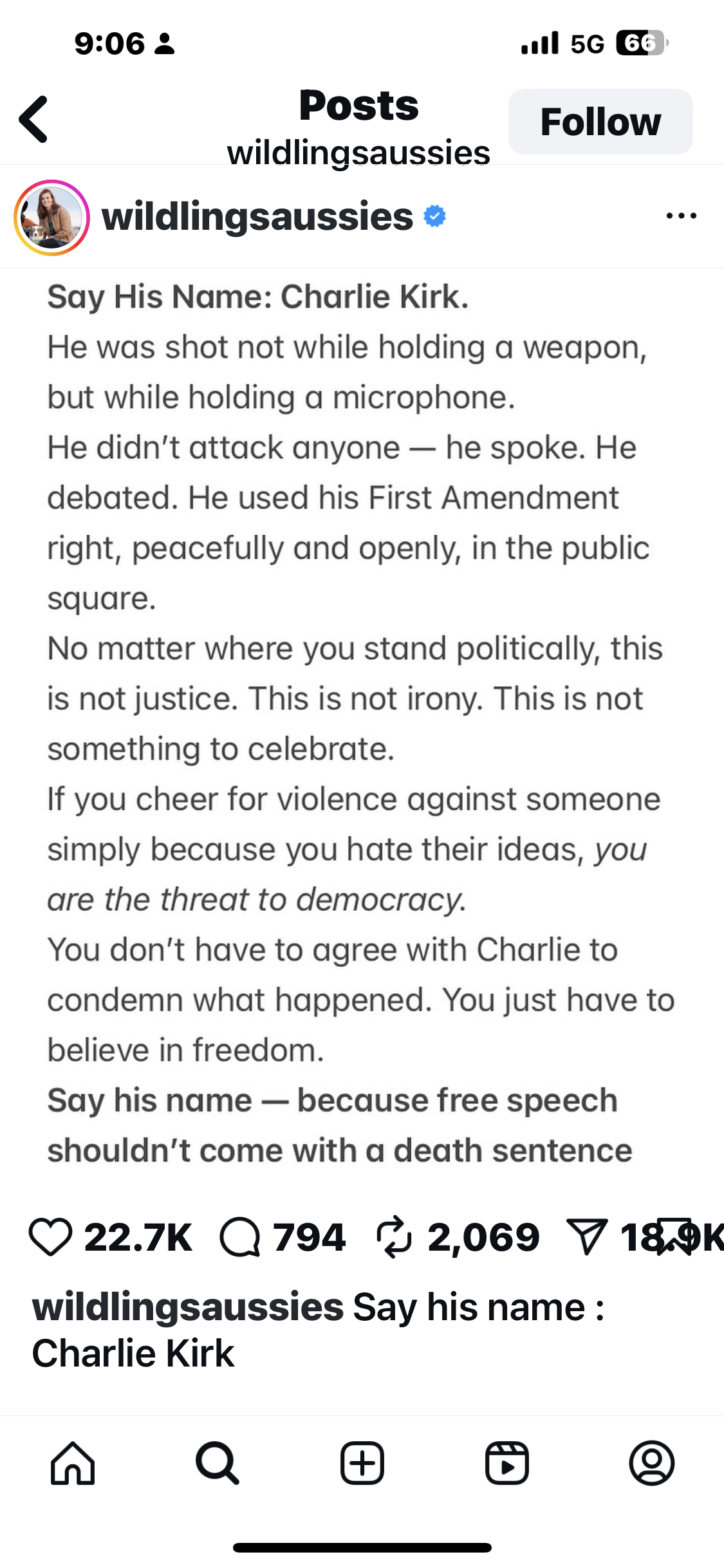
That’s the crossroads we face as a nation. Will we continue to normalize violence against those who think differently, or will we honor Charlie by embracing debate without dehumanization?
Final Reflections
Charlie was a man of faith. I believe his soul has already moved on to a higher purpose, perhaps even shaking his head at us, saying, “These humans still don’t get it. They’re still fighting. They’re still hating.”
His death leaves us with a choice. We can let the violence intimidate us into silence. Or we can honor his memory by carrying his mission forward: speaking truth, keeping dialogue alive, and refusing to let fear win.
Commentator Brad Polumbo captured it well:
“I will pray for his family and honor his legacy of modelling civil discourse and debate.”
That’s exactly what Charlie would want. Not violence. Not vengeance. But courage, faith, and the conviction to keep speaking.
One of his last tweets said it all:
“Get married, have kids, and stop partying into oblivion. Leave a legacy. Be courageous. Happy Sunday and God bless all the parents out there.”
Charlie did exactly that. Now it’s our responsibility to carry that courage forward.
And in his memory, I feel personally obligated to finally follow through. For years, I’ve hesitated to launch this site — Rise & Rekindle’s manifesto explains why — out of fear. Fear of speaking too boldly. Fear of being misunderstood. Fear of what it means to stand alone. But Charlie showed us we don’t have the luxury of silence anymore — something I wrestled with in The Internet Is a Dumpster Fire — Because We Let It Be.
If his legacy teaches us anything, it’s this: truth must be spoken, courage must be lived, and hope must be rekindled. That’s what I’m committing to here — and I invite you to join me.
If this resonated with you, I invite you to do two things:
Because legacies only endure if we carry them together.



Comments ()