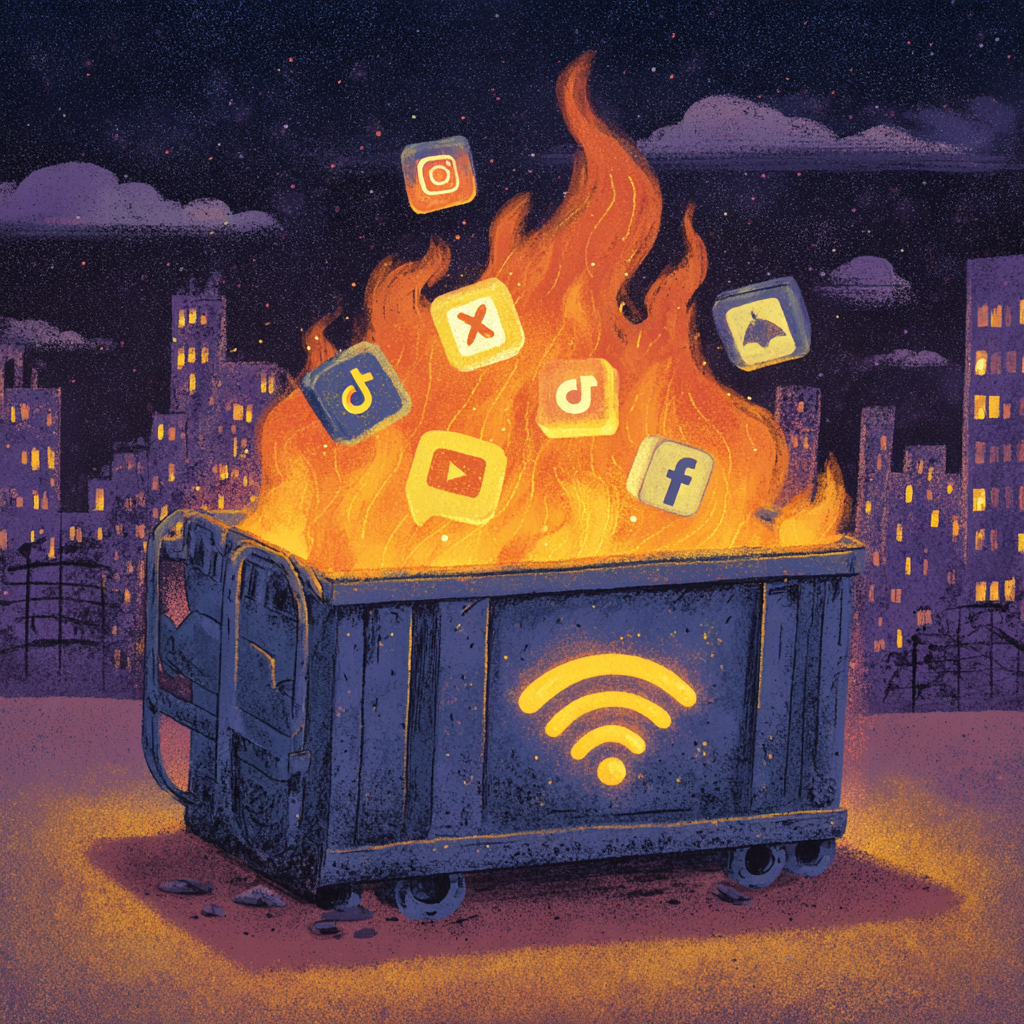
The Internet Is a Dumpster Fire — Because We Let It Be
How online culture slipped into chaos, and why the grounded majority needs to rise up and reclaim the narrative.
Before this site had a name, this was the spark that lit the match.
I wrote it as a way of stepping off the sidelines and into the mess—because staying quiet while the loudest voices shape the world is no longer an option.
We can do better, but only if we stop waiting for someone else to go first.
I used to be part of the problem.
Not intentionally, but like most people, I spent years trapped in the noise—scrolling, sharing, reacting, believing I was “informed” simply because I was engaged.
But it wasn’t until I left social media that I realized how loud and shallow everything had become. It was keeping me from thinking for myself. From seeing the bigger picture. From recognizing how much we’ve let the worst voices dictate the tone of the entire internet.
The internet is a mess—not because of one side or one group, but because we all let it get this way.
The loudest, most extreme voices run the show—while the rest of us sit back, scroll past, and assume it’ll balance itself out.
But here’s the truth: the internet is a reflection of what we allow. If we keep stepping back, the worst voices will keep stepping forward.
It’s time for the Grounded Majority—the people who still believe in logic, reason, and basic human decency—to step up.
How the Internet Got Away from Us
I was born in 1981, making me a millennial on paper, but in reality? I identify much more with Gen X. My generation was the last to grow up without the internet and the first to be thrown into it headfirst. We weren’t taught how to use it—we were just handed the internet and expected to figure it out.
And at first, it was amazing.
The early internet felt like an expansion of the real world—a tool to connect, to learn, to communicate. But somewhere along the way, the internet stopped being a tool—and became the world itself. Now, what happens online doesn’t stay online. It spills into our daily lives, affecting elections, policies, workplaces, and even relationships. And yet, the people who contribute the least to real-world progress hold the most power online.
Here’s why:
1. The Loudest Voices Are Driving the Internet Off a Cliff
The people who thrive in today’s internet culture aren’t the thoughtful ones. They’re not offering real solutions. They’re the ones who stir the pot, spread outrage, and capitalize on division—because it works.
Let’s break it down:
Chaos Amplifiers thrive on controversy. They don’t care if what they’re saying is true or productive—they only care about engagement. Think Joy Reid, Sunny Hostin, and Whoopi Goldberg on The View—loud, inflammatory, and more interested in dunking than discussing. Their goal isn’t clarity; it’s clicks.
Trend Surfers don’t fact-check—they jump on whatever is popular, even if it’s completely untrue. These are the celebrities posting carousel “activism” on Instagram without understanding the issues, or brands suddenly flying flags in June with no real-world advocacy behind them. This kind of performative activism waters down real advocacy and makes meaningful change harder to recognize. It’s virtue signaling dressed as value.
Algorithm Manipulators fuel division because they know outrage keeps people clicking. Rage-bait content creators, clickbait headlines, and emotionally charged viral tweets fall into this camp. They game the system—and they’re winning.
Here’s the kicker: these groups aren’t the majority. They just act like it.
And because we let them dominate the feed, they end up dominating the conversation.
2. The Rest of Us Are Scrolling Past the Problem
The problem isn’t that reasonable people don’t exist—it’s that we’ve been conditioned to stay silent while chaos dominates the conversation.
We see the misinformation, the bad takes, the toxic debates, and we keep scrolling. Because what else can we do? Getting involved feels like stepping into quicksand.
But here’s the issue: silence is permission. Every time we scroll past the chaos, we let it shape the world we live in.
3. The Internet Fuels Victimhood and Social Contagions
One of the most damaging effects of the internet has been the rise of the victimhood mentality. Instead of promoting resilience, personal responsibility, and problem-solving, the digital space rewards and amplifies victim narratives—whether real, exaggerated, or completely fabricated.
- Misinformation and Digital Outrage: Online mobs can spread misinformation at record speed, leading to canceled careers, ruined reputations, and public shaming—often without due process or verified facts.
- Historical Parallels: The Satanic Panic of the 1980s–90s is a prime example of mass hysteria fueled by media. Today, the internet accelerates ideological contagions even faster.
- The Cult of Victimhood: A study from PsyPost found that individuals who strongly identify as victims are more likely to engage in cyberbullying themselves, showing how the internet enables a cycle of grievance and retaliation.
The internet isn’t just a tool—it’s a mass influencer, shaping how people think, feel, and interact with reality.
4. The Internet Fuels Mental Illness and Social Isolation
The effects of the internet on mental health and human connection are undeniable.
- Teen depression and anxiety have skyrocketed. According to a 2023 CDC report, teen suicide rates have increased by 57% since 2007, coinciding with the mass adoption of smartphones and social media.
- People socialize less in real life. A 2021 study by the American Psychological Association found that young adults spend 70% less time in face-to-face interactions compared to 20 years ago.
- Social media addiction is real. Research from Common Sense Media found that 50% of teens feel “addicted” to their phones, and 78% check their devices at least hourly.
- Algorithms are shaping self-worth. Studies show that social media engagement affects dopamine levels, reinforcing addiction and shaping self-esteem based on likes and shares rather than real-world accomplishments.
I see it firsthand as a parent—my youngest son would stay online all day if we allowed him. And what he’s exposed to? It shocks me—not just the content, but how effortless it is to stumble into disturbing, inappropriate, and even harmful material.
Our mental health crisis isn’t just a societal issue—it’s an internet issue. It’s an algorithm issue. It’s a constant exposure issue. And the longer we ignore it, the worse it gets.
How Do We Set Digital Norms Without Censorship?
Right now, internet moderation swings between two extremes:
- Too extreme—people get banned, shadowbanned, or censored for saying the “wrong” thing.
- Too lenient—anything goes, leading to toxic, harmful spaces where harassment and misinformation thrive.
We need a middle ground—a way to set reasonable expectations for online spaces without suppressing free speech.
Some solutions to consider:
- Public vs. Private Spaces — Just like we have public parks and private clubs, online spaces could have different standards.
- Content Warnings Instead of Deletion — Flag content appropriately rather than banning it.
- User-Led Moderation — Let communities upvote/downvote misinformation instead of relying on top-down control.
- Expanded User Controls — Let users mute words, limit interactions, and curate feeds.
- Rating Systems — If movies have PG-13 labels, social platforms should too.
- Platform Transparency — If companies profit off user behavior, they should disclose how algorithms work.
If we can agree on standards for behavior in real-world spaces, we can do the same online.
Who’s Already Fighting for a Better Internet?
A small group of people are holding the line—pushing back against misinformation, challenging the algorithms, and injecting sanity into digital spaces. But they’re outnumbered. That’s why we need more people to step up instead of just watching from the sidelines.
Some orgs leading the way:
- Family Online Safety Institute (FOSI) — Focuses on digital responsibility for families.
- The Cybersmile Foundation — Works to prevent cyberbullying and online abuse.
- Internet Matters — Supports safer online experiences for kids and parents.
And it’s not just organizations holding the line—there are independent voices out there trying to bring sanity back to the conversation.
I’ve found a few who continue to challenge mainstream narratives with clarity, reason, and unapologetic honesty:
- Brad Polumbo – A libertarian voice calling out political spin, media bias, and bad-faith arguments on both sides.
- Mody Speaks – A fearless cultural commentator dishing out harsh truths on race, identity, and modern hypocrisy. She’s not here to soothe you—she’s here to dismantle bias, and that’s exactly why I keep listening.
- Arielle Scarcella – A lesbian libertarian unafraid to speak out on women's rights, LGBT overreach, and what the trans movement is doing to kids.
- Amala Ekpunobi – Once a far-left activist, now a truth-seeker bringing calm, grounded insight into trending topics and ideological blind spots.
- Brett Cooper – Witty, bold, and culture-savvy, Brett challenges mainstream narratives without screaming about them. She brings humor and heart to the uncomfortable conversations—and that’s rare.
These creators don’t all agree on everything—and neither do I—but they’re helping build the kind of internet I want to be a part of. One that questions louder, listens deeper, and thinks harder.
Final Thoughts: The Internet Won’t Fix Itself
The internet has rewired how we think, feel, and interact with reality. But that doesn’t mean we have to accept it.
Younger generations grew up with no separation between online and offline. To them, this is just the way things are.
But that doesn’t mean it’s the way things should be.
If we don’t step up, the loudest, most toxic voices will keep shaping the world we live in.
So ask yourself:
What are you going to do about it?
I spent too long scrolling past the madness, thinking it would balance itself out. But staying silent only gave chaos more room to grow.
Writing this was my first step in pushing back. And if you’ve made it this far, maybe it’s yours too.
Final Call to the Grounded Majority:
If you’ve felt the shift—if you’ve watched the internet go from useful to unhinged—you’re not alone.
We’re not crazy. We’re just quiet.
Too quiet.
But silence only serves the chaos.
So let’s change that.
– How has the internet bled into your real life?
– What digital norms need to go?
– Which independent voices are helping you think clearer?
The louder the extremes get, the more important it is for grounded voices to rise.
If this article lit a spark in you—share it.
Let’s reclaim the narrative together.



Comments ()